Thank you to everyone who joined us for our first webinar of 2026 on AI and the future of audio tours.
If you missed it or want to revisit key moments, we’ve published a blog post with highlights and insights from VoiceMap CEO and founder Iain Manley, and the full webinar recording is available on YouTube.
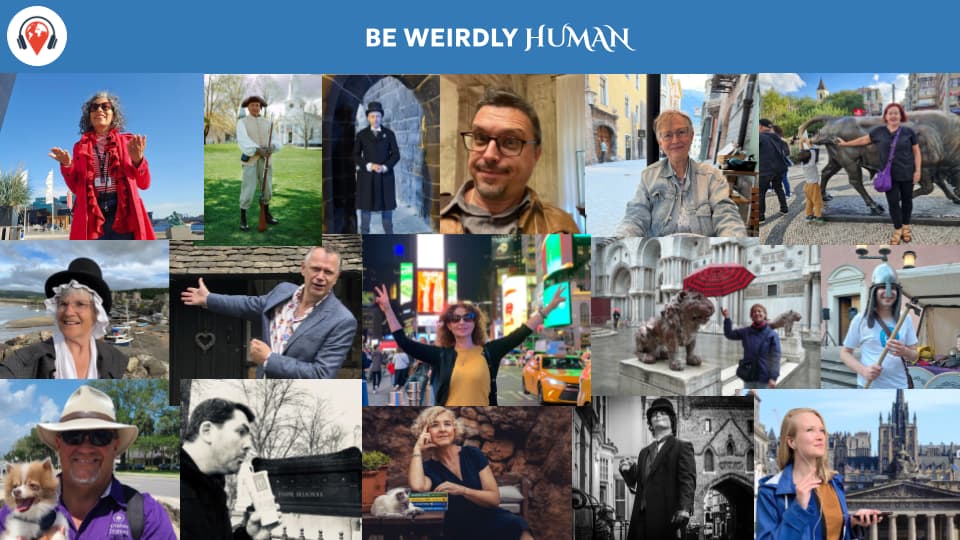
What We Mean by Being “Weirdly Human”
The future of storytelling belongs to those willing to be weirdly human – to lean into the quirks, tangents and strange fascinations that make you specifically you.
As a publisher, you have something AI fundamentally can’t replicate: you’re actually in the world. You’ve walked your routes, got lost, stumbled on something unexpected. You’ve made routing decisions based on how a place actually feels. AI can generate competent words, but it can’t navigate actual space or accumulate the thousands of choices that turn information into art.
But being there is only half of it. The other half is helping listeners see a place through your eyes – transforming information into connection through phrases only lived experience allows: “I remember,” “I love,” “I hope.”
VoiceMap was built on one principle: helping people see a place through somebody else’s eyes. There’s neuroscience behind why this works – when someone tells a personal story, the listener’s brain syncs with the storyteller’s, engaging in a process called neural coupling.
Technical competence is now cheap. Humanity paired with storytelling craft is rare. And that’s where you have the advantage.
AI as Your Assistant, Not Your Replacement
Think of AI as your research assistant and writing partner – not your replacement. Here’s how publishers use AI at different stages:
- Mapping and research
AI excels as a research assistant – uncovering historical details beyond surface-level sources, finding interesting quotes and obscure facts that you’re not going to get on the first page of Google.
For example, if you’re researching a specific building or event, AI can help you find actual quotes from historical figures or point you to sources you might have missed. You then use these research findings to craft your own narrative in your own voice.
- Scripting
AI can be a writing partner when given proper context. Publishers mentioned feeding in their route outlines and research to an AI project with clear instructions that the content will be spoken rather than read. Some train AI on their personal writing style, but always as a tool to amplify their voice, not replace it.
A comment from @heidinicklaus160 : “I love using AI to help determine the best way to explain something complicated. Like the tripartite government in Bosnia – ‘explain it to me like I’m 8 years old.’”
This is one of AI’s most practical applications – simplifying dense historical or political content while you maintain the authentic voice and perspective. The key is to work in chunks with detailed prompts, then make the output your own by working through it line by line.
- Recording
There’s no substitute for a real human voice. VoiceMap tours are human narrated. Interestingly, when tours sound too polished, listeners increasingly assume they’re AI-generated and leave negative reviews feeling “tricked.” Vulnerability and authenticity have become assets. Publishers who embrace their authentic voice – imperfections and all – see stronger listener engagement than those aiming for studio polish.
- Translations
There’s no substitute for a human voice, but AI can help extend your reach.
A comment from @lahelgen : “Today one of my tours was published in a language version with my AI-based voice – and I’m genuinely impressed with the result. If used correctly, this is a fantastic tool.”
Tools like ElevenLabs can be trained on your voice in your native language, then generate narration in other languages that still sounds like you. This lets you offer tours in languages you don’t speak while maintaining your authentic voice. If you’re interested in translation support, have a read here.
One Step You Can Take Today: Update Your Publisher Profile
Google now specifically rewards human experience over AI-generated content. This is your moment to stand out.
We recently updated all publisher profiles to align with Google’s E-E-A-T framework. This means your profile is now a powerful tool for discoverability – both for people searching directly and for AI tools like ChatGPT that use Google’s rankings when suggesting things to do. When your profile demonstrates lived experience and authentic expertise, you’re more likely to appear in these searches.
What to do:
- Go to your publisher profile
- Expand your bio to at least 150 words (Google won’t even index profiles shorter than this)
- Add credentials that demonstrate your experience and expertise
- Add or update all the relevant links to your social media and other online presence
One publisher raised a great point: “The challenge is balancing the need to list serious credentials for Google’s purposes against the need to seem like a fun and interesting storyteller.” The good news is Google’s looking for a mixture of signals – it’s not just academic qualifications. Your passion, lived experience, and authentic perspective all contribute to authority. Have fun with it!
You’ll find more details and examples on our documentation.
VoiceMap Tours Will Remain Human-Created
To be clear: VoiceMap tours are created by human publishers. You can use AI as a tool for research, script refinement, translation, and generating reference audio. But the routing decisions, personal perspective, and authentic voice must be human – yours.
The generic won’t age well. Just as early cinema audiences jumped at the sight of trains approaching on screen, AI-generated content initially seems impressive. But people are rapidly getting savvier, and tours that put a person in front of the content will increasingly be what they seek out.
The future of storytelling belongs to those willing to be weirdly human.
Collaboration Opportunities
We have a forum category where you can connect with other publishers for translation help, voice swaps, and collaboration. You can find that here.
If you’re interested in creating tours for organisations, we’ve also added an option to publisher profiles to indicate your availability for commissioned work. Tom Raffe will cover this in detail in our February webinar.
Upcoming webinars:
- 18 February 2026: Selling to Businesses with VoiceMap Head of Commercial, Tom Raffe, and UK publisher, Becky Frost. More soon! Register here.
- 18 March 2026: Storytelling with Tom Darbyshire, the storyteller behind TellBetter audio tours
And as always, if you have questions about profile updates or using AI in your tour creation process, drop them in this thread.